Showing posts with label Health. Show all posts

23 February 2017

Injury part 5: have I achieved my goals so far?

It’s time to check in with the aims I set myself last month to see how the reality has matched up with what I was hoping for


It’s been about a month since I blogged about my goals, and three months since I had surgery, so I thought now might be a good time to look at how I’m doing.

My big achievement is that I’m back at work. It’s for three days per week at six hours per day at the moment, but still, I’m there. I actually started off doing just four hours per day so even six is another improvement. I definitely feel good about this. It’s a huge step forward and has definitely boosted my confidence.

My current 10am start is really very civilised and I wish I could do this all the time. Three days isn’t enough time in which to get everything done, however, so I’m hoping to go up to four soon.

It hasn’t been easy, though. My first week back was very hard. I did Wednesday to Friday, with no time to recover in between. By Friday night my leg was agonising and I was in tears. The following week I did Monday, Wednesday and Friday and that worked well, but the week after I had physio on Monday and worked on Tuesday. That evening was simply horrible.
My big achievement is that I’m back at work
Even worse, though, was last night (22 February). I’d worked two days on the run at longer days of six hours. But the real difference was that I’m now taking the bus, rather than taxis, to work. Both the journey in and home were hellish and I suffered as a result. I was in agony last night.

That said, using the bus is another huge achievement. I’ve not been on public transport since the accident and managing to take the bus has been a major confidence boost. It’s also meant that I’ve been walking a lot more. Getting back on public transport wasn’t on my original list of goals but with hindsight it should have been.

I'm back at Birdwatch, right on schedule. 

I haven’t managed a walk to the marshes, which I’d planned for mid-February. And I’m now certain that I won’t be back on my bike by early March. Instead I’ve moved the walking to early March and will aim for my first bike ride some weeks after that.

I charged my vivosmart today, so from tomorrow I’m going to be wearing that again. Tomorrow is a work day, so I’ll be walking to the bus stop and then walking from Wood Green High Road to the office, and then doing the same in reverse at the end of the day. My step count won’t be high, but it’s a start.

24 January 2017

Injury part 4: setting goals

As my recovery continues – slowly! – I’ve decided it’s time to start putting in place some goals to work towards


I’M quite goal orientated. I like to-do lists and deadlines. I think it’s because my brain is always so busy that the only way to ensure anything gets done is put it in writing. Also it’s so satisfying to put a little tick next to a task that I’ve completed.

I’d like to set some goals for my recovery, but this has been impossible as it’s so hard to predict the speed of that recovery. For example, I had no idea I’d be off work for as long as I have been. But since having physio on 17 January I’m seeing improvements in my mobility almost on a daily basis. Admittedly these are incredibly small, but they’re improvements none the less. So I’m feeling a little bit more confident about setting myself if not hard and fast goals at least some things to aim for.

Inevitably most of these will be physical, but I’m going to include some entertainment too, if only so that I’ve got things to looks forward to. Some will have dates attached to them. These might have to be revised or simply missed, but I’ll just have to be open minded about it. I’ve added all the dates to my Google Calendar so I can keep referring to them. This is meant to inspirational and encouraging, so I’m not going to get downhearted if I miss any dates. They’re more guidelines than rules.

Back to work
This is the biggie; the sign that things really are progressing. At the moment I’m signed off till the end of January. If I continue to recover at the same rate I think I should be able to return to work on 1 February. I might need a phased return. I’ll have a better idea towards the end of the week, when I’ll need to speak to my GP again.

I’ve got another physio appointment on 13 February and I’m waiting for an appointment to see orthopaedics, both of which will impact my being at work. The date of the ortho appointment might dictate when I return to work.

Getting back to work is important, if only for it being a huge leap forward physically. However, I am feeling rather odd about it. Being off work for this length of time has really knocked my confidence. I feel anxious about the job, about being in the office, about getting to the office, about talking with my colleagues, about whether I’m even needed back. The only way to address these fears is just to go back, but I can’t do that until I’m physically able.

The Red Shoes was my first show, back in December.
I spent the whole thing in pain and had spend the
next day sleeping it off. 

Long walks
This is the next thing on the agenda. I can walk, after a fashion, and I’ve been getting around the house without crutches. But this isn’t the kind of walking I’m talking about. I’m talking about getting to the marshes, walking to Stoke Newington, trekking along the River Lea towpath. Proper walks. I can’t do these yet and it’s going to take some time.

I’m going to set a provisional date as mid-February for this.

My Garmin VivoSmart might be of use for this. For obvious reasons I’ve not worn the VivoSmart since 22 November. But putting it back on now might encourage me to get out a bit more. The more I get out, the quicker I’ll be back to proper walking strength. Obviously I won’t be aiming for 10,000 steps from the off – more like 10! – but having them counted up and displayed on my Garmin Connect account should act as an incentive for me.

Back on the bike
This is another massive milestone. It’s impossible to put a date on it. I need a lot more flexibility in my knee in order to push the pedals round; at the moment I can only just bend it to 90 degrees.

I really want to get back on my bike, but at the same time it scares me. What if if happens again? I don’t know how I’ll react when I do try to ride again. I might freeze and not be able to do it. Cycling will be a huge confidence boost, though, and it’s an important step in my recovery, both physically and psychologically. I want to do it as soon as possible, but it entirely depends on how quickly I can get full movement back. I reckon I’ll have a better idea after my next physio appointment. Maybe I should aim for my first bike ride to be in early March?

First sportive
The Cambridge Gran Fondo is on 4 June. I signed up last year long before the accident. It’s 80 miles through largely flat terrain. I would love to be able to do this. June seems like a long way off right now, but I’m not even back on the bike yet and don’t think I will be before the end of February. I might have to let this one go.

The next sportive I’m booked on is VeloBirmingham, a new 100-mile event in Birmingham. This is in September and I shouldn’t have any problems making this one. I’ll also have a new bike to show off. Whether I’ll do any others over the summer depends on how quickly I recover. It would be nice to do some shorter ones with my mum.

Back to yoga
At the moment I probably miss yoga more than I do cycling. I didn’t have a yoga accident, so there’s no fear associated with it.

Again I’ll need much more flexibility before I can even contemplate a yoga class. This is another aim that will have to wait till after my next physio appointment. It’s something I can ask the physio about, along with any advice on getting back on the bike.

I’m going to provisionally pencil this one in for the beginning of April.

I really want to get back on my bike, but at the same time it scares me. What if if happens again?
First show
This won’t actually be a first as that was back in December when I went to see The Red Shoes at Sadler’s Wells. However, I spent most of that performance in pain and slept most of the following day. I would like this to be a pain-free show.

There are several I’d like to see. Art at the Old Vic closes on 18 February. I suspect I’ll have to give this one a miss. At the moment I can’t sit for very long without my leg being elevated, although I could probably do a couple of hours. But it’s not just a case of sitting. I also have to get there. I’m not happy with the idea of public transport yet. The injury is still very painful and I really don’t want to risk it getting knocked about.

More realistic is Don Juan in Soho at the Wyndham Theatre. This is on till 10 June, and quite frankly if I’m not OK with using the tube by then, there’s something seriously wrong. May might be a good month to aim for this one.

Then there’s my favourite: dance. There are loads of things on at Sadler’s Wells that I’d like to see and this venue is easy to get to by taxi. First up is Gala Flamenco (23-25 February). There are tickets available for the matinee on 25 February. I think this is doable if I go by taxi and only take in the show. It’ll be after my second physio appointment and hopefully after the ortho appointment. I’ll (hopefully) have been back at work for a while.

But what I really want is to be back to my normal experience of going to Highbury & Islington station, preferably with my mum. We walk along Upper Street and stop somewhere for lunch. Then we head to the venue, watch the show and then walk back, stopping along the way to have a glass of wine. It’s really very pleasant. For this I’ll need to be walking properly and be fine on public transport.

For this I’m thinking of the Northern Ballet’s Casanova. This looks amazing – beautiful, sexy and seductive. It’s on in May, which should give me plenty of time to be ready.

Exhibitions
There are two I want to see. The first is Maps and the 20th Century at the British Library. This closes on 1 March, which means the latest I could see it is 26 February, the last Sunday in the month. I think I might have to let this one go.

More realistic is Philippe Perreno’s Anywhen in Tate Modern’s Turbine Hall, which closes on 2 April. I love the installations in this room. I love the way the artists have risen to the challenge of using the space and the way their works interact with it. I love the fact that Tate kept the hall as it was, rather than giving in to the temptation to split it up into more easily managed galleries. This particular work is said to “challenge your perception of time and space” and it sounds fascinating.

If I plan to go over the weekend of 25-26 March this gives me a full two months from now (24 January), as well as four months since the surgery (23 November) for recovery. This should be plenty for my knee to be healed, for me to be confident on public transport and to be OK with walking quite a distance. Heck, I might even be able to cycle there!

First holiday
This is another thing that was booked long before the accident. I’m heading to Grantown-on-Spey for 5-9 April with my mum. This is to be my third attempt to see Capercaillie. By this time I’m hoping to be OK. I should be able to walk and drive and sit on aeroplane.

But again we’ll have to see and take it as it comes. If my mum has to drive, so be it. If we can’t do the walking that we’re planning, so be it. If I have to pay Easyjet extra to change seats so I can keep my leg extended, so be it. We will go on holiday and we will enjoy it. We might even see Capercaillies this time – I think I deserve some luck!

I’ve diarised these goals for the first half of this year, culminating with the Cambridge sportive on 4 June. I’m sure I’ll have to revisit and revise some of the dates, but it’ll be interesting to see how my actual recovery matches up to my plans.

24 December 2016

Injury part 3: ways to stay positive

It’s not easy to remain positive when you’re stuck indoors and barely able to walk. So here are some of the things I’ve been doing to look on the bright side


I am struggling with this injury. There have been times of utter despair, of endless tears, of feeling like I’m never going to recover. As someone who’s generally very active, enforced inactivity is hard; constant pain is even harder. And sometimes it really does feel like I’m going to be like this forever.

It’s not always dark, and some days are much better. I try to stay positive and here I’d like to share some of the ways I manage to – and just maybe they’ll help others going through similar experiences.

Keep busy
This is the obvious one: occupy your mind and you won’t have time to dwell on what could go wrong or why it’s taking so long to heal. It’s also easy. There is an incredible number of things to do without ever leaving the sofa.

Netflix seems to be making an awful lot of original sci-fi series, which is great for me. I’ve already watched all of Brazilian dystopian show 3% and The OA. The former was excellent; the latter was weird. I've got The Expanse lined up for next week. I’m not as impressed with Amazon Prime Video. It won’t, for example, let me ‘rent’ Top Hat, so in order to watch the film I have to buy it for £13.99, despite paying for the service. The second series of The Man in the High Castle is available, though, and I will watch that.

I’m also knitting, reading, colouring and designing a website. I’ve got more than 400 books on my Kindle and I’ve almost finished knitting an insanely complicated shawl. I’ve probably got more colouring books and pencils than I can use in a lifetime.

This is Dawson, the bike I was riding when I came off.

The website is called Ride Guides and I’m designing it using WordPress, which has involved learning how to use WordPress. I found this quite difficult and have had to download a few beginners’ guides. It’s been quite a steep learning curve, but it’s also been fun. There are still some things I need to figure out, but I hope to launch the website soon – watch this space!

Mindfulness
When I first started hearing about mindfulness I thought it was new age hippy shit. But then I realised that dismissing something out of hand was as bad as accepting it without question, so I did some research. It turns out that there’s a huge body of work showing that mindfulness can be very helpful in treating conditions such as anxiety and depression. It’s been used extensively by cognitive behavioural therapists in the States.

So I gave it a go. There are several apps out there that offer free trials of their guided meditations, and I’ve tried two. First was Headspace, which I didn’t really get on with. But then a friend recommended Calm and I gave the Seven Days of Calm free trial a go. I liked it so much I subscribed – the only app I’ve ever paid for. I’m currently working my way through the 21 Days of Calm programme. I used the Emergency Calm mediation in hospital when I was in a blind panic about having surgery. It really did calm me down.

I find it very hard to switch off my brain. I’m constantly thinking about past conversations or planning future ones, which leads to all kinds of feelings of anxiety and inadequacy. Mindfulness helps this.

Stay connected
It seems to be very trendy to bash social media at the moment and there are any number of self-congratulatory articles on The Guardian in which the authors make themselves feel superior to the rest of us by giving up social media. But I love it. While I was in hospital Facebook gave me a much-needed lifeline to friends who kept me feeling positive, who offered the right combination of humour and support. Twitter keeps me connected to the wider world.

I need my friends, and Facebook and Twitter mean that it’s almost like they’re with me in my living room even though in reality they’re all over the world.

Gratitude list
I wrote a list of all the things I’m grateful for related to the accident. Things like the injury not being much worse, which it could have been, and The Chap being self-employed and working from home, which meant he was there to take me to A&E and could stay with me the whole day. I read it back to myself when I’m feeling particularly down.

Silver lining
The idea of this is to identify some positive outcomes from a negative situation: find the cloud’s silver lining. This is really something that needs to be done in retrospect, after the good effects have become a bit more obvious. One thing I can say, though, is that I had previously been feeling incredibly stressed at work. After three weeks off and a couple more to go, all that stress has disappeared.

Future cycling self
This is adapted from a mindfulness task in which you picture your best possible future: your ideal job, relationship, friendships, home, hobbies and so on and then write about it all for 15 minutes.

It’s not easy getting out of the house when you’re recovering from an operation, but if you can, do it
Instead of concentrating on my fears that I’ll never be able to ride a bike again, I pictured my future cycling self taking part in one the long-distance sportives I love so much. I imagined how it would make me feel: all that joy and freedom, the achievement of crossing the finish line, the shared experience with thousands of other riders, the pride in taking part in such a big challenge.

I wrote it all in my notebook and this is another thing I can refer to when I’m feeling down.

Getting out and about
I can’t overstate the importance of this. Since coming back from the hospital I’ve been out of the house four times (not including trips to the GP). Each time has meant increased pain both that evening and the following day. It’s been worth it.

Three of these trips out have been to a local coffee shop called Today Bread. It’s not even five minutes walk away under normal conditions; on crutches it takes me 15 minutes. But it’s got huge tables and plenty of space so I’ve got lots of room to sit with my leg stuck straight out. It’s also got lovely food. Just going there for a coffee has improved my mood considerably.

It’s not easy getting out of the house when you’re recovering from an operation, but if you can, do it. It really does help.

13 December 2016

Injury part 2: the psychology of fear

The physical challenges of recovering from an injury are just half the battle. Here I look at much trickier issue, the mental aspect


THIS post was much harder to write than the previous one, it’s also more important. Recovering from an injury is hard. Physically it’s pretty simple: rest it, elevate it, regularly move my toes, ankle and knee to keep it mobile, and trust to modern medicine and my own body that it’ll heal properly. The psychological side is a whole lot more complicated.

Being in almost constant pain is incredibly emotionally draining. By the end of the day I’m exhausted. Some days I feel like I’m not coping very well. Saturday (10 December) was bad; Sunday (11 December) was much better. Monday (12 December) was up and down: from joking and laughing to sobbing in a matter of moments. I spent much of Saturday in tears, while the pain was exceptionally high.

And the smallest thing can set me off. The Chap has to bring my clothes down for me. He brought cycling socks by mistake and I said they were the wrong sort. He quite reasonably asked what difference it makes. It doesn’t, not really, but it did matter to me and I was in tears.

On top of that I’m worried that it won’t heal properly – that I’ll do something wrong and tear it open again or I won’t get full mobility back so I won’t be able to do all the things I want to. I’ve always been very independent and very active. As well as cycling, I go to yoga a couple of times a week and do a lot of walking. I’d be devastated if I could no longer do all of this.

I’ve already missed out on two things I was very much looking forward to: The Nutcracker at the Royal Opera House and Peony Pavilion at Sadler’s Wells. The first would have been my first-ever trip to the Royal Opera House and my first-ever traditional ballet. The latter was a production by the Chinese National Ballet and looked like it would be absolutely beautiful. I was to go with my mum and she went with my aunt instead, so the tickets didn’t go to waste, which I’m very pleased about. But I’m so incredibly disappointed that I didn’t get to go.

I understand that it’s unlikely that the wound will re-open or that I’ll never walk again; my mind is just being melodramatic. When I’m already feeling down and tired, though, it’s hard to fight off such negative thinking.
It was a pretty bad injury that’s going to take a long time to fully heal and coming to terms with that after being generally very fit and healthy is difficult
Physical activity is a big part of my life. I use it to stay healthy, fit and happy. Exercise helps keep my depression at bay. So not being able to do it is worrying. I’m also concerned about putting on weight. Not really the time to fret, I know, but I can’t help myself.

I love cycling. The thought that it might not be in my future worries me. It’s not so much the physical ability – that I can build up again. No, it’s the fear. When it comes to getting back on the bike, will I be able to? At the moment when I think about my bike I see that stretch of road where I came off. I shudder and wince. Fear goes right through me. What if I can’t get over that?

I’ve always been a pretty fearless cyclist. I cycle through London rush hour traffic every day; I’ve done 100-mile rides; I worked out a route and rode from Walthamstow to Windsor on my own. My bike gives me so much joy, and I am truly scared that I could lose that.

I suspect I’m suffering some sort of post-traumatic stress. It was a pretty bad injury that’s going to take a long time to fully heal and coming to terms with that after being generally very fit and healthy is difficult. We live in a world where we expect everything to happen instantaneously and that breeds impatience. I’ve got nothing but time in which to sit and brood about what could go wrong.

There’s no quick and easy fix. Telling myself to stay positive is all well and good, but how? Mindfulness meditations help as they keep me in the present, whereas these fears are all about what’s already happened, and therefore unchangeable, or the future, and therefore unknowable. Keeping busy also helps, and I’ve got on hand books, writing, knitting, free courses from FutureLearn, even designing a website. I know also that when I do climb back on the bike I need to take it carefully. Short rides on quiet roads with no time constraints and build up slowly to where I was before the accident.

One thing I’m going to try is ‘silver lining’. This is something I came across recently and it involves looking for any positive outcomes from bad experiences. Not in a pseudo-spiritual ‘everything happens for a reason’ or ‘the universe made this happen because …’ way, but rather identifying concrete examples of good results. It’s a bit too soon right now, but one possible upshot could be unlimited amounts of zen-like patience …

10 December 2016

Injury part 1: the accident and the aftermath

I wasn’t going to do this, but writing is therapeutic for me and I feel the need to get it all out. In part one of my examination of my recent accident I look at the physical aspect: what happened and how I got fixed


A note on photos: the first photo is just my leg in a bandage. It’s suitable for all. At the very end of this piece there’s a photo of the knee after the stitches came out. This is more 12A than U. If you’re squeamish you might not want to look. The photos of the open wound are definitely not for putting here, but I’m happy to share them if anyone wants to see them …
AS some who read this blog already know, a couple of weeks ago – on 22 November – I came off my bike. I’ve fallen off a few times before, but nothing like this. I’m not entirely sure what happened. One minute I was cycling along going onto the cycle path from the road (surely a safety-conscious move?) and the next I was sliding along the pavement unable to stop myself.

I hadn’t hit the curb (it was a drop curb) or a rock or wet leaves. I wasn’t going overly fast. I wasn’t weaving in and out of traffic. The bike just went from under me. All I can think is that I hit a patch of diesel. Part of me wishes I had been doing something stupid or dangerous; at least then I could look to what I’d done and not do it again.

I hit the ground hard and my momentum dragged me along on my left knee. A woman taking her kids to school stopped and offered to call an ambulance. A couple of police officers offered to call their van to take me home. I declined both. I wasn’t far from home and was sure I could easily get back. Some schoolgirls even stopped and offered me a drink of water. Walthamstow really is lovely sometimes.

So I walked for a bit and then got back on the bike and cycled home. I honestly thought that all I’d done was skin the knee and knock it about quite badly. I even sent a text to my boss saying that I’d just fallen off my bike and I’d be a bit late for work. It wasn’t until I got my cycling leggings off that I realised how wrong I was. There was gaping hole in my knee about 13cm across, 5cm wide and almost down to the bone. “I need to go to A&E,” I told The Chap, in a somewhat understated manner. He took one look and panicked. He tried to phone for an ambulance but couldn’t remember the number …

He did manage to get through but they wouldn’t come out, so we had to call a cab. We also needed to wrap the wound somehow, but have any bandages so had to rip up a T-shirt and tie that round my leg, Rambo style. The drive was awful. We were in peak drive-the-kids-to-school time and there were roadworks; every bump in the road jounced my leg, causing me agony. I didn’t cry, though.

A&E was much like you’d expect: lots of waiting around while I was seen by a succession of nurses and doctors. I was given some codeine for the pain. The wound was x-rayed and properly bandaged. We also took some photos so that different doctors and nurses could see what had happened without removing the bandages every time. I’ve still got the photos; they’re grim.

Eventually we got to see the orthopaedics doctor, and that’s when the bombshell was dropped. The wound was too big to sew up under a local anaesthetic, I was going to have to have surgery. “And I want to keep you in overnight,” she concluded. This was when I started crying. Up to this point I was convinced that they were just going to stitch me up and I’d be back at work within the week. It didn’t occur to me that I might not be going home that day. I’ve never had surgery, never even had local anaesthetic never mind a general, and never spent the night in hospital. I was terrified.

My bandaged knee after the surgery. You can see the bruising and where they had to draw an arrow
to make sure they operated on the correct knee.

The doctor added that she would be happy with me going home if we promised that if there was any change or if blood came through the bandage we would come straight back. She left the room to give us a bit of privacy. I was sobbing. “I just want to go home,” I said. So that’s what we did. It wasn’t my best decision. I settled down on the sofa, had some lunch and was about to turn on Netflix, when I thought I should just check the bandage, just in case there was some blood, convinced there wouldn’t be. You can probably guess the next bit. The bandage was soaked.

“I think we need to go back to A&E,” I said. So for the second time that day The Chap called a cab and off we went for more sitting around. When we saw the orthopaedic doc again, she looked at me and asked “Can I keep you in this time?” I could only nod. So we waited in A&E for a bed to come available. It took hours; apparently there’s a shortage of beds across the whole of the NHS.

It’s weird being in hospital overnight. Lights go out at 11pm, but it’s never truly dark. It’s never truly quiet either and I’m so very grateful for a friend’s advice to take earplugs. The nurses were also taking blood pressure readings and so on at regular intervals through the night. They’re very careful but it’s hard not to wake up. Another thing I’m grateful for, as it meant I was awake at 2am, the last time I could eat anything in order to have the surgery that day. I had a banana.

The doctor who was to perform the surgery visited me on his rounds that morning. He assured me they would try to see me in the morning, but they couldn’t promise anything. I was also seen by an anaesthetist who turned out to be a cyclist too – the first thing he asked was if the bike was ok – and the pharmacist, who was pretty hot, so that cheered me up somewhat.

I spent most of the day in a blind panic about the operation. I even had to do an emergency calm mindfulness meditation, which really helped and I’d recommend it to anyone in a similar situation. I use the Calm app and it really does work. I’m currently working through the 21 days of calm meditations. In the end I went down for surgery at 3pm, by which time I’d not eaten or drunk anything for 13 hours.
I was totally blown away by the professionalism, compassion, respect, patience and kindness demonstrated by everyone with whom I came into contact
The anaesthetists put in a drip, which was an odd experience. I’d been feeling very dehydrated but almost immediately that went away. They also asked how I was feeling. “OK,” I said. “Just very scared.” They reassured me that they would look after me, and they really did. In fact all the staff were fantastic. I was totally blown away by the professionalism, compassion, respect, patience and kindness demonstrated by everyone with whom I came into contact. It might be self-evident that people in caring profession are likely to be, well, caring, but it’s not until you actually experience it that you realise just what that means.

After I’d come round, the cycling anaesthetist came over and agreed that it was indeed a very bad injury. Then I was wheeled back to the ward. The Chap was already there. My notes said I could go home if safe, but there was no way that evening. So I had another night in hospital. And the next morning brought more sitting around as I waited for orthopaedics to release me. One nurse: “I’ll phone up to them again. I’m so sorry – I wish I could do more.” I went home around lunch time.

So now, almost three weeks later, I’m confined to the sofa, being looked after by The Chap. I’ve had the stitches out; the knee is constantly painful and I’m on all kinds of painkillers. I still can’t walk without crutches, but I’m trying to keep bending my knee, ankle and toes just to return a bit of movement. It’s not easy. It hurts and I’ve been very emotional; I’m going to talk more about the psychological aspect in part two of this post.

Below the line is a photo of the injury after the stitches came out. If you don't want to see, turn away now.


It's not that bad, but you can see the extent of the wound and the bruising around it. 

27 March 2015

Using tech to get healthy

My Fitness Pal is a website and app that helps you keep motivated to get fit and lose weight


The MFP website. I've burned more than 300 calories today.
I do quite a lot of exercise, so I’m pretty fit and healthy. However, I’m not entirely happy with my weight – or rather my size as it’s the fit of my clothes by which I tend to judge. When it comes to weight loss – as oppose to getting fit or maintaining a healthy weight – it’s 80% about cutting calories rather than upping burning them. So it was time to change my diet.

I haven’t made major changes. More fruit and salads and smaller portions, cutting down on the amount of oil used in cooking, cutting down a bit on carbs. Small changes that are easy to maintain. I don’t believe in denying myself, so instead of cutting out foods like cake and chocolate, I just have them in small pieces. I don’t diet, as such, as I don’t believe it works. This is about retraining my eating habits to be healthier – for good.

It does get rather dispiriting at times, though. Especially when you see someone tucking into a huge piece of cake and can’t help but think ‘Why can’t I just eat whatever I want and not put on any weight?’ Which is why you should never compare yourself to others. Heck, for all I know that person might run straight to loo and throw up everything they’ve just eaten. And that’s certainly not something I want to be doing.

Mr motivator
Staying motivated when these thoughts hit can be challenging. So after a bit of advice from friends I did what I usually do and turned to the internet. My Fitness Pal is a website and app. It’s easy to use and really quite simple – you input your weight, how much you want to lose, the time scale and various other personal data.

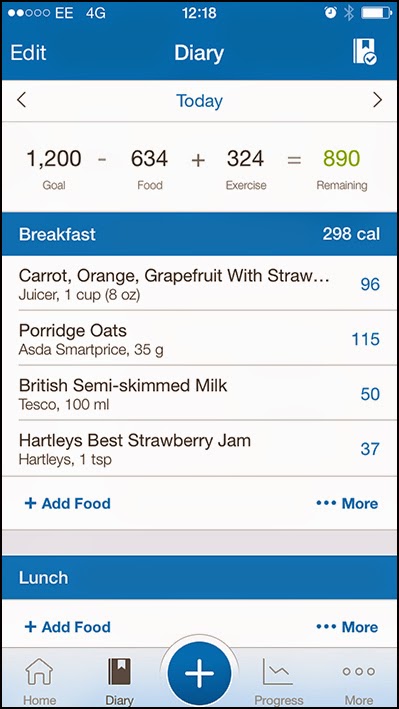
The app, showing my healthy
breakfast of porridge and jam!
MFP then generates a daily calorie target and you just log the food you eat and the exercise you do. The number of calories you burn is offset against the number you take in and when you’ve finished your food and exercise diary for the day the software will calculate your weight loss (or gain!) if you ate like this every day.

It’s been an absolute revelation to me. Weight loss advice nearly always includes keeping a food diary, but I’ve never seen the point. I know what I eat during the day, so why would writing it down make a difference, I always thought. How wrong I was. The knowledge that everything you’ve eaten will be there in black and white (or rather pixels) for you and all your MFP friends to see really does make you think about what you’re putting in your mouth. It also turns out that I’m really quite competitive – not so much with other people, but with myself. I really want to ‘win’ at losing weight.

This hasn’t meant that I’ve particularly been denying myself, but I do think more about my caloric intake. I’ll maybe eat a smaller dinner if I want to have cake. I also do an awful lot of exercise to offset those calories.

It also works well with other software I use. I recently invested in a Fitbit to count steps on days off the bike (usually Wednesdays and Saturdays). Your Fitbit account can be linked to your MFP account, so the calories you’ve burned by walking are offset against what you’ve eaten. I’m also a huge fan of Strava, which again can be linked to your MFP account.
I’ve never seen the point of keeping a food diary; how wrong I was
I’ve been seriously impressed at how smoothly all these various things have worked together. All three are both website and app based, and all I’ve had to do is tap the relevant button on the apps to link them up. Then the data is automatically transferred. MFP then tells me how many minutes I’ve exercised and how many calories I’ve burned per day and per week. It’s been really quite eye opening to see just how much I work out these days.

But the real test is whether it’s worked – have I lost weight? Well, yes, I have, though not quite as much I’d hoped. But I have lost size. Those trousers that were a bit tight fit properly again and I’ve gone down a notch on my belt. I suspect the main reason the weight isn’t going down as quickly I wanted is the amount of exercise I do. I’m building muscle tissue and losing fat, which is a good thing. The fact that I pretty much eat my own body weight in crisps whenever I get drunk is probably playing a part too, though.

3 February 2015

What this girl thinks of This Girl Can

A new project to encourage more women to participate in sport is a fantastic idea, but is there a touch of sexism about it?


This Girl Can is a new campaign aimed at getting more women and girls into sport. It’s a fantastic idea. Women are under-represented at all levels of sport, from taking part in it at both amateur and professional level, to media and TV coverage, all the way up to management and governing bodies. In fact, research carried out by Sport England (the organisers of the This Girl Can campaign) shows that 1.75 million fewer women than men regularly take part in sport or exercise, while of the 1.3 million coaches in the UK (across all sectors of sport), only 17% are women.

Much of this is to do with good-old-fashioned sexism and the old boys’ network that operates across much of our society. But there are other factors, many of which I believe start in school.

Women’s bodies are scrutinised in ways that men just do not experience or understand and this happens from a young age, as soon as puberty begins. We are put under huge pressure to conform to an unrealistic and unobtainable ideal, and if we don’t measure up to it we’re not good enough – in our own eyes, in those of our friends and the men and boys we’re told we need to impress. We worry that we’re not fit enough, not thin enough, not skilled enough, and that we don’t look good enough in lycra.

When I’m working out I don’t care about my wobbly thighs or love handles
With all that self-judgement going on it’s no wonder we don’t want to get out there and play sports or hit the gym. There’s also a fear – particularly among teenage girls – that sport isn’t feminine and that exercising too much will make them muscular and unattractive.

This Girl Can seeks to address these fears and lack of self-confidence. There is much to love about the campaign. The fact that it even exists is a huge step in the right direction. Sport England are going all out on it. There’s a website, Twitter account (with attendant #ThisGirlCan hashtag) and TV and billboard advertising. And judging by the tweets I’ve seen using that hashtag it’s working. Woman all over the country are responding favourably. At time of writing, the advert had been viewed 5,279,704 times on YouTube, having been online for just two weeks.

To really judge the effectiveness of the campaign, though, Sport England will have research whether more women are taking part in regular exercise. I hope the organisation does take the time to do this.

Screen shot from the This Girl Can TV ad.
I love the way they’ve used women of all shapes, sizes and ages. I refuse to use the term ‘real women’ – the idea that a woman is less real than another because she’s skinny is as abhorrent as insisting that all women must be thin. Black and disabled women are also represented. The women are shown doing all kinds of activity, from dance classes and netball to boxing and football.

The ad uses some inspiring slogans: “I swim because I love my body. Not because I hate it”, “I may be slow, but I’m lapping everyone on the couch”, or “I kick balls. Deal with it”.

But – you knew that was coming didn’t you? – there are elements I’m not so enamoured of. Slogans like: “Sweating like a pig, feeling like a fox”, “Hot, not bothered”, or “My game face has lipstick on it”.

I don’t know about you, but when I’m training feeling hot or foxy is not a priority, and I certainly don’t get fully made up before getting on the bike. This feels like a retrograde step to me: it’s reducing women to physical appearance again, telling us that what we look like is what’s most important about us. It’s “Hey girls, do some exercise and you’ll be more attractive to boys.”

Like many women I have issues with my body, but when I’m working out I don’t care about my wobbly thighs or love handles. Pushing myself to get up that last stretch of hill or swimming against the tide in the sea, I don’t care about feeling beautiful, because I feel strong, healthy, powerful. It’s about the only time I’m truly proud of my body, of what it can do.

Screen shot from the This Girl Can TV ad.
Taking part in exercise brings with it all kinds of benefits, both mental and physical. It can improve self-confidence. Joining clubs, teams or groups widens your circle of friends. It makes you stronger, fitter, healthier and can mean you’ll live longer (importantly it also increases the quality of those extra years). You’ll probably will lose weight; or size, at any rate, as changes in muscle: fat ratio could mean an increase in weight despite getting smaller.

All of these things in combination will almost certainly make you feel and look more attractive. But this is secondary to all those other fantastic benefits, and it’s those benefits that the campaign should be centring on. Can you imagine a similar campaign aimed at men and boys telling them they look foxy?

But maybe I’m over-reacting. The campaign appears to have gone down very well in general, and maybe I should just be glad it exists. What do you think?

21 January 2015

Living with depression

Mental health isn’t easy to write about, but it is important, so here’s my take on depression


When I first started this blog I decided it would only be about cycling; any other topics would be covered in my Idoru Knits blog. However, I’ve changed my mind and I’m going to extend the blog to general fitness and health, including mental health. It’s not easy to talk about mental health, but I believe it is important. So today I’m going to discuss my depression.

A lot of people suffer depression: about 350 million worldwide, according the World Health Organisation. Many of those people will have a mild episode which will be treated – either with talking therapies or antidepressants – and recover, never to suffer the illness again.

There are still days like this, but
they're far fewer than they used to be.
My depression isn’t like that, though. It’s just always there. I’m no longer on antidepressants. I came off them after four years and a course of cognitive behavioural therapy. Coming off them was a big step for me, one that meant a lot. But it didn’t mean that the depression had gone away. Part of dealing with this illness – for me, at least – was accepting that wasn’t ever going to go away.

On a day-to-day basis this doesn’t affect my life massively. There are certain things that I know will bring me down – not eating properly, not getting enough sleep, too much stress – but these are generally things that I would avoid anyway in pursuit of a (mostly) healthy lifestyle. I have to give myself extra time to recharge after a busy period at work and I can’t deal with crowds anymore.

I keep a mental eye on my mood. It’s normal for everyone to feel down sometimes, but I need to be aware of this in case it’s a sign that things are getting bad again. This isn’t just a pointless, navel-gazing exercise – it could save my life. I realise that sounds ridiculously melodramatic, but it is true. I’ve had three separate episodes of feeling suicidal and it’s only the love and support of friends and family (and antidepressants) that have kept me from acting on this.

Sometimes, however, I have bad days. These are days when even getting off the sofa is too much effort. They’re far fewer than they used to be and not as severe. Time was when I couldn’t even get out of bed, never mind make it to the sofa.
There was no way I was going to be able to carry out those plans. Leaving the house or doing actual physical exercise were beyond me
Sunday (17 January) was one such day. I had things planned. I was going to go on a bike ride. First to Wanstead Flats to see a Slavonian Grebe – a rare bird in London that’s been using the Heronry Pond on the flats as its home for the past week or so – then to Stoke Newington for lunch and a trawl of the charity shops.

There was no way I was going to be able to carry out those plans. Even knitting or reading was beyond me, never mind leaving the house or doing actual physical exercise. I hate it when this happens, when this illness stops me doing things I enjoy, things I’ve been looking forward to. But of course feeling like that is counter-productive. It makes me worse, giving the depression a stronger hold on me.

Part of living with depression for me is knowing when to give myself a break. Knowing that it’s OK to lie on the sofa listening to Radio 2 all day, and to not beat myself up when that happens. For me there’s no such thing as beating this illness or even of controlling it. It’s about dealing with it and not letting it beat me.